Friday, March 27, 2020

Don't know


Right now it seems like something really big is going on.  The Covid-19 virus is making a lot of people sick and a lot of people are dying. but there is something closer than the foreground of that image.  Right now, in so many ways, I don't know what is going to happen.

I don't know what is going to happen to the people I love,

I don't know what is going to happen to the classes I am trying to teach,

I don't know when I am going to visit friends

I don't know what the impact of this is going to be on my job, my kids, the economy, etc.

This "I don't know" is something different from the actual virus.  It is something different than my job or the stresses of social distancing.  It is like the smudges on your glasses that you can easily forget are there.

Most of my day I have a sense of of what is going to happen next.  I'll shower, make breakfast, do some work, meditate, hang out with the family.  But that sense of knowing what is coming next really is an illusion.  This illusion is common among people.  I find that the truth is I don't know what is going to happen next.  There are few forces that will disrupt my routine, but countless things that I have no control over can derail my plans.

A heart attack, a bout of depression, a broken toilet, an upset child, a forgotten deadline or even just a better plan.

I draw a sense of stability from knowing what is happening and knowing what is coming most of the time.  However, right now, everywhere in the world, all at once, every one of us doesn't know.  That doesn't feel pleasant, especially in the midst of a disease that is causing so much direct and indirect suffering.

A lot of people are dealing with "not knowing" fairly gracefully.  Others are not.  Sometimes I am, sometimes I am not.  For me, being at home and working from home pushes hard against my edges.

Part of not knowing is realizing that I don't have the answers, but I will share what I am doing in these times.

Being a school teacher, I have a certain amount of experience dealing with large blocks of unstructured time, though I still need to work from home and do what I can to help the people in my life.

I keep regular hours during my workweek.  I get up between 6 and 7, shower, dress for a regular day, have breakfast with Julie and look at my schedule for the day.  With Ontario schools closed, we developing how to support the kids from home.  As a special needs teacher, this is pretty complicated, but everyone is working on it.

I am really restricting my media intake.  What I need to know about Covid-19, I get from the CBC, the CDC, the WHO and a website which compiles official statistics:  www.ncov2019.live

I am making a point of getting outside each day.  A bike ride, a walk in the neighbourhood, throwing frisbees around the park.

I meditate, pray and chant everyday.  These are very specific tools to help me do 2 things.  First, they help keep me from automatically grasping on to the panic that social media and my own mind try to put in my way.  Second, they help me keep my my mind oriented towards kindness.  When I don't know, I find that leading with compassion is good for my spiritual and physical heart (plus it doesn't throw gas on the fire).

I am cleaning the garage.  This is a big one for me, especially after a winter.  I'd share a picture, but the drastic contrast would escape most everyone.  My father-in-law has seen that horrible pit and would likely be impressed with its current state.

Finally, I am trying to find ways to stay connected with people in my life.  I find that what is coming from people who are sharing their direct experiences on social media to be very positive and supportive, (better than a lot of the stuff that is reshared).  I am playing games online with strangers and with friends.  I am also participating in livestreams with my Sangha in Toledo.  "Sangha" is a Buddhist term that basically means community.  I very grateful for this community in particular.  There is nothing quite like trying to navigate these troubling times with a bunch of people who have vowed to encounter the moment with wisdom and compassion.

I don't know how this will all turn out or when things will improve.  But here is what I do know:  if I lead with kindness and compassion for myself and others, I will be doing the best I can for myself and others.

May we all be safe.
May we all be healthy.
May we all be happy.
May we all be at ease.


Thursday, June 18, 2015

Transition to a new page

If want to stay connected with this blog, you can continue to follow us by searching Norhtern Sky Zen on the web or on facebook.  This blog will be inactive but will remain as an archive.

Sunday, May 31, 2015

Pain and Suffering


Earlier this week,  I dove to the bottom of a pool to retrieve a stone.  As a result I ended up with water trapped in my ear.  I couldn't get it out and neither could the doctor.  The pressure and pain came on almost immediately.  While the pain was severe, the location of the pain made it omnipresent, but not incapacitating.  I continued to work, care for my kids, play in a staff golf tournament and prep for my daughter to host a sleep over.  All while in unignorable pain.

When we engage our lives as practice, encountering physical pain gives us an opportunity to study the difference between pain and suffering.  And to be clear, there is a difference.

In this case, the pain looks like a throbbing in my left ear that amplifies my tinnitus tenfold and lets me hear my heartbeat in the painful throb.

The suffering might look like this:  

  1.  "uuuuuuunnnnnngggghhh when is it going to stop? uuuuunnnggh?" (as a continual 4 hour thought)
  2. the neck and upper back tension unconsciously held to accompany that thought. (so it won't get lonely)
  3. "This is Bullshit!  I was just getting over a cold and now it is reasserting itself!"
  4. "Damn it!  If I hadn't had that bicep surgery I'd still have sick days and could take time off to deal with this."
  5. "This should be a great day!  Instead I have to deal with this crap!"
  6. "Ear drops?  You'd think a doctor could just suction it out."
And on and on.  Now, as in zazen,  thoughts are going to arise.  That is not a problem.  But when these thoughts a fed, nurtured and given priority and weight, there is suffering.

When I was young, and long before I encountered Zen and a practice, I used to train in Tae Kwon Do.  I can remember harnessing some kind of Star Trek, Mr. Spock mojo to try and separate myself from my physical pain as though I was observing it from outside.  The pain still hurt just as much, but sometimes it seemed more manageable.  Although it was still there I could work with it, rather than being something that consumed my consciousness.

Today I woke up with less ringing and less throbbing.  For now at least, the big pain is gone.  I offer my practice and intention to those who deal with chronic pain, but more so to those who deal with chronic suffering.

Wednesday, May 20, 2015

Developing Vow


Beings are numberless.  I vow to save them.
Desires are inexhaustable.  I vow to end them
Dharma gates are boundless.  I vow to enter them
The Buddha Way is unsurpassable.  I vow to embody it.

  Over the years, I have chanted different versions of this, but it remains the most constant invocation that I use in my practice.  However, the way I hold it has changed.

It used to feel like a 'damn it all' determination from some over the top WWII movie...

Officer:  Who could we possible send?
Sgt:  I'll do it
Officer:  But it's a suicide mission!  You'll never make it!
Sgt:  Why should that stop me?  [jumps out airplane door]

yeah, it had that kind of edge to it.

These days, my understanding of this vow has more to do with the kind of mind it can cultivate.  If you set the intention to really fulfill that vow, then you need a develop patience and kindness with others, but more importantly you need those things for yourself.

While the piss and vinegar determination of that heroic paratrooper seems to give good momentum, it will eventually crash and burn, taking you with it.  The cliche that life is a marathon, not a 100 yard dash is useful here.

You can reach out to save another;  any Bodhisattva should.  However, if the other is not in the right place, they may not want to be saved, or even be aware that anything is wrong.  Our ability to receive help from others is the same way.

We can encounter a teaching, but if the conditions are not correct, we may not be in place to understand and receive it.

As a high school teacher, my job is to impart knowledge, and then send those kids along, while receiving a new group in need of the same help.  What actually is useful for them might not show up until much later in life, if at all.  As well, it is unlikely that the impact I have will be the result of some life changing lesson that I alone imparted to the student.  More likely, what I bring to the table is part of a broad fabric that (hopefully) nourishes the student and gives them a chance to grow.  In my life, the fact that I will not see the extent of this impact is a given.  All I can do is set the intention, take the vow and try to help.


Thursday, April 30, 2015

With Purity Like a Lotus


For most of us, at least those who find themselves here on this path, we want to do something about delusion and suffering;  both our own and that of others.  We spend our time at the beginning of practice, developing the capacity to recognize distraction, see it for what it is, let it be and return to the place we choose to place our attention.

In our work to end delusion, this is a very big deal.  In essence we are deluded when our mind sees or weaves a reality that is something other than what is actually going on around us.  As we develop this capacity, so to do we work to end delusion and reduce suffering.

In practicing this, the ground is sewn with the potential for great compassion.  It is on this feild that I am encountering some of the hardest or sharpest edges of my own practice.  On this ground, I find it realitively easy to be compassionate towards those I love, those I don't know and even towards myself.

Where it often breaks down for me is how to practice and manifest compassion towards those people who irritate me, anger me, and (in my view) don't seem to give a damned about anybody else.  What compassion looks like when these situations present themselves is hard to pin down.  In my irritation and anger I tend to see them as a villain, as eveil, as someone who is setting out to be a jackass.  In this disturbed state, I can imagine no other way that it could be.

But what I forget, what I need to cultivate is the very awareness that lead me to practice in the first place.  

Delusion and suffering abound.  I should do something about it.

In these dark and red moments, I fail to see that the being in front of me also lives in the grips of delusion, assaulted by the pull of greed, anger and ignorance (each to their own extent of course).  Like myself, their own conditioning might run so deep that I may never make an impact on it, but knowing that there is darkness and suffering, how can I not try to help?  It doesn't really matter if it is helping myself, my child, that guy, or THAT guy.  We all live in the midst of the muck and the darkness, but in practice we see that it does not have to define who we are or limit our capacity to respond.

At the end of Oryoki (the meditative meals taken on sesshin) we chant: "May we exist in muddy waters, with purity like a lotus..."

Not "may exist apart" or "May we exist protected from".  To alleviate suffering, we aspire to exist IN muddy waters.  We aspire to exist there, because that is where we find the beings most in need of the alleviation of suffering, including ourselves.

Today, as I step out the door, I set the intention to not have blind spots in which some of those beings might hide.

May compassion and peace abound.

Wednesday, April 22, 2015

Ease off and Pass Through


Rinsen Sensei suggested that we post some of our thoughts on the text we are reading this Ango.  In the Canadian sitting group, we have been taking turns selecting a passage and reading it to the group just before we sit, and then discussing it during tea at the end of our practice time.  As a result, we have been moving through the text in a less than linear way.

As I move though the various chapters, I continue to come back to a portion of the introduction.

"By the examination of his own thoughts, emotions, concepts, and the other activities of mind, the Buddha discovered that there is no need to struggle to prove our existence, that we need not be subject to the rule of the three lords of materialism.  There is no need to struggle to be free; the absence of struggle is in itself freedom. This egoless state is the attainment of buddhahood."

For me, this passage has been part of an ongoing reminder, that we make, or at lest feed our own problems.  We worry;  we imagine arguments and worst case scenarios.  We create barriers.  We build gates.

The world we encounter is just as it is.  We apply the judgement and drama.  Sometimes, things need discernment.  Action based on clear judgement is required.  However, we tend to over do it.  Through a lens that is clouded by worry about the past and future and imagined transgressions, we judge and discern in ways that are excessive and unskillful.  

When we...

release the tension / stop the struggle / drop the story / stop giving our energy to the drama...

we can find our grounded center, even as it floats freely in the middle of the chaos.  Out of that center, we can act without struggle.

For a very long time, there were certain situations in which I could not stop struggling.  If I felt that I had been wronged by others, I would have an incredible sense of entitlement to my anger.  So strong an entitlement, that letting go of the anger was not an option.  It deserved to be nurtured.  It deserved to live.

However, when I would meet with these people, I would more often bring kindness, forgiveness and honest presence.  All the anger and fighting was reserved just for me, when I was alone in the dark hours.  Far from any sense of healthy indignation, this anger fueled a one man war, of which I was always the primary casualty.

I recognize the feeling of this shift much more easily these days.

Like a sigh.

Like easing into a hug as you realize you just can't do it anymore.

Like redirecting the tension and pivoting when uke comes in hard and fast.

Like the moment you release from the first stretch of the day, while still lying in bead.

This is not giving in.  When the struggle stops, it is not because we curl up and wait for death.  These struggles are often our attempts to make the 'then' or the 'now' be what IT IS SUPPOSED TO BE DAM IT!  When we stop the struggle, we can be present to what is actually true in the moment.

Right now, beautifully, it is the calm quiet just before we put the kids to bed.

Sunday, December 7, 2014

Emptiness

sigh......  I should post here more often.

Right now.

Right now I am in the middle of a semester at work that has been particularly challenging.  There is poison and it is hard to deal with

Enmei is having her own challenges in returning to the classroom, and sometimes we have felt too down to be the rock for the other.  So we have held each other, both of us down, and held on.

We are on the verge of a move that has left the house 3/4 packed and with a feeling like someone has pushed a pause button on much of the activity of my life.

Yet, everything seems to be both going fast and standing still.

Enmei has just left for a three day workshop and the house seems very empty despite the activity of a teenager, her little sister an their father.

There is great activity, but there is great emptiness.

There is great activity, yet there is great silence.

It is thus, at least for now, but it is changing.

One of my working edges right now is a refocussing on my center.   Working to not be swayed by internal and external environments.

Working in this way with external environment is fair;y obvious as a process.  Even when I see myself affected by it, playing into the drama, I still know I am not these things that happen to me.

The internal environment is more difficult to work with.  I can say "I am not my thoughts" but when the anger or the sadness arises, it is more difficult to see them as something other than myself.

And so I practice.

And so I return to the center.

And so I remember to not confuse the sky with the weather.

And so I continue to work with the one point and the sky in this midst of activity and stillness.  In chaos and silence,

Wednesday, August 20, 2014

A New Autumn

I think it is safe to say that we, as a society, traditionally see Spring as a period of birth and beginnings, while Autumn is a period of letting go and preparation for endings.

However, my personal experience has been somewhat difference.  I am not sure it is because of the practice or if it is because I am a school teacher, but I tend to find a certain energy in the end of summer.  It is a sort of determination that carries a deep intention to improve on past weaknesses.

I have face many school years as both a student and a teacher, and although there have been a number of months, semesters and years I might rather forget, the hope of the Autumn remains unblemished.

From the perspective of Zen, Autumn is a time to turn inward.  This has nothing to do with shunning the world, but more with increasing the focus on the inward eye.  Zazen can happen at anytime or any place, but the cooling of the days has a way of providing more opportunities.

Soon, the Fall Ango will be upon us and we will be asked how we will amplify or expand our practice.  Such a decision is worthy of our attention now.  Intention tempered by reflection over time is a power thing.  Not powerful like a hurricane, but like a river that runs fast and deep in search of a great ocean that it already touches.

The end of summer deserves its share of melancholy, but only as far as it is the result of a settling of activity.

Tuesday, January 7, 2014

Seasons

I can remember a time in my life when things were all or nothing.  I'd plan a big change and it would work out, or it would be abandoned.  Life never really worked out that way, but that was the way I approached it.

These days I have come to recognize the seasons of things.  Rather than forcing all things into being or extinction, I find that I am getting better at noticing the shifts of things.  When to push forward, when to back off.

Appropriately enough, the this shift came gradually.  Learning to let things rest, to just be what they are until they need to be something else, is a developed skill for me.  It is not an easy thing.  It can be very difficult to not burst in and start projecting myself on a reality that does not fit my perception.  It also takes a lot of attention to make sure this does not just become passivity.

Vague enough?  Sorry.  That's the way it feels right now.  The winds are changing, or maybe it's just a gust.  We'll see.

Monday, December 12, 2011

The Matrix


When Rinsen (my primary teacher) talks about what enlightenment is not, he often makes a matrix reference, saying that it is not like you can suddenly see the matrix code. The world seen before this incredible insight is the world that is seen after.

From what I have seen in this life, primarily in the teachings of enlightened beings and my observations of them, this appears to be so.

However, analogies are limited and can be applied in a variety of ways. So without disputing Rinsen's observation or claiming to have reached a great enlightenment, I'd like to make the statement: I have seen the matrix.

It was early in the morning, just the other day. The environment was quiet. My mind was quiet. Then as I moved into the shower, I became keenly aware of myself as the observer of my own mind. The incoming data (warmth, wetness, stiff muscles, eyes squinting against bright lights) was being filtered through my experience and seen by my mind.

In computer science with Mr. Murphy back in the mid 80's, we learned that data is just data. Although the program and the data need each other to make things happen, data flows forward without intent or value until it is processed through a program, or if you will, a matrix.

That program or matrix can take that data and use it to detonate a bomb, make blips on a heart monitor or tell you when the oven is hot enough to bake cookies. The nature of the program determines the nature of the data.

Our minds are very much the same way. The direction, intent and adaptability of our mind will determine how it processes the day that unfolds before us. This is not to say the solution is to just stay positive. For me the key seems to be mental flexibility, but I digress.

What I am getting at is the idea that our minds are the matrix. I believe it is possible to see the nature of one's own mind.

In that moment, moving to the shower, I saw the possibilities of the day that lay ahead. Not in the data, but in the clarity and pliability of the matrix that would process it. The day unfolded in a seemingly ordinary way. Pleasant and unpleasant things came up. I'd like to say that I did not let my mind amplify any of the negative things. I can't though. I can say I saw it, caught myself, and to the extent that I could, I made it better.

I like my analogy. I recognize that it is being used in a very specific way. In the end, what do we see when we see the matrix? We see a day. Just a day. Unlike any other.

Saturday, November 12, 2011

My Ducks

(picture taken last Spring with my eldest daughter)

Recently I was able to attend a Sunday service at TZC. The format usually makes for a fairly short talk, but this one was one of the more notable ones I have heard in a long time.

Rinsen spoke of ducks.

The gist of it was the nature of ducks vs. our tendency to want our ducks to be in a row. As he explored this, my mind tried to identify it's ducks. (given that the mind is one big duck to begin with) Today however, I found one of the more disorderly bunches of ducks that I have been hanging with. Collectively, they are my house.

In August we had some flooding in our basement and the repair work (covered by insurance) has been very slow. The contents of our basement were moved to our living room and our garage. The short of it is that our living space consisted of a kitchen, 3 bedrooms and 2 bathrooms for 3 months. I have been very stuck in the mind that says "I'll be happy when all of this is done and I have my house back". Although I am happy that the repairs are almost done, I can see that I have been playing a very dangerous and unhealthy game with my own mind.

As drastic as the damage to the basement was, I have to recognize that even now there are issues. Things to be worked on and repaired. The new paint and carpet will get dirty or chipped. The idea that there is a perfect way for my basement to be, is a static view of a dynamic situation. Even as the ducks seem to be coming into line, I have to recognize that they will drift apart again.

This was basically what Rinsen was getting at, but it is much more useful when these things can be seen in our own lives and not just as abstract concepts.

I am going to go downstairs now and play with my ducks.

Friday, October 21, 2011

Why Me?


Lately I have been going through some minor plagues. Nothing major, just a torn calf muscle and some colds and flu's. But for most of the time I was going through it, it FELT major. It felt terrible. I felt terrible. I felt like my entire life was crumbling around me. It took some time to create the space I needed to work through it, but once I did, I spent some time thinking about how situations like this arise.

What I found was not earth shattering, surprising or even new, but it came from a different angle and provided some insight.

In the physical universe, there are countless bodies in motion. Every body has a gravitational field and that field acts on every other body in the universe. This creates an infinitely complex and dynamic relationship between everything in existence. Pull back far enough and it can be seen that there is a geographical center to the universe, and everything is moving outward from that. Some theories hold that the universe will eventually collapse back to that point in the Big Crunch.

But that is not where we live. We live in eddies of activity and drama. We exist in currents of dynamic drama with people we did not know 10 years ago and who will not always be a part of our lives. We live in homes that will decay and eventually be abandoned, regardless of how much time and money we put into them during our lives.

We move through these swirls of life and activity from which there cannot be perceived a center. There is only motion, in even in stillness.

Then a moment comes. We might perceive some subtle agency behind a collection of our circumstances that brings us to wrongly pursue a line of thought based on an idea that we are getting more than our own share of suffering and calamity.

What is your due portion of calamity? Really?

I played a bit of poker in my life. I know how the odds work. In Hold'em, if you are chasing a flush after the flop, you have approximately a 36% chance of making your hand. But YOU WON'T ACTUALLY hit that flush 36% of the time. You'll die first. To get what the odds say you should get you'd have to play poker forever. The closer that your time playing gets to infinity, the closer your outcome will reflect the odds. Despite this, many players decide poker is rigged because they are hitting their hands less often than they "should". Others feel they have something called "luck" on their side because they seem to make their hands more than they "should".

What is your due portion of luck? Really?

So what happens when my world is collapsing around me? Having made the error of thinking there is a certain amount of luck or calamity that I should have, I place myself in the center of the universe. This is a terrible place to be. When you are at the center of the universe, the universe is either running away from you, leaving you alone and isolated, or it is rushing towards you, threatening to crush you.

When I slip, it is a slip into the center of the universe.

For me, when I break out of these frames of mind, it is usually the result of displacing myself from the center of the universe. I might see it through the suffering of another person, or even from just looking up and truly seeing the unblemished sky that covers all the beings of this planet.


Saturday, October 1, 2011

Parks and Rec


Julie asked why I was putting trip reports on my Zen blog.

Where else would I put it?

I know it is not particularly reflective like most of my other posts, but there is more to contemplative life than reflection. There is also awe and living. Short trip that this is, there is a many layered beauty in it. The movement through this country is parallel to the movement through this life. The depth of connection between Julie and I, although it is always there, can ride at the surface of our awareness in those brief moments away from familiar places and faces.

There is beauty.

--------

Friday night we went to bed early. I won't say it was a mistake, but in the morning we knew we had to force ourselves to sleep long so we would be better able to handle the day.

Saturday morning we went for a walk in the rain after breakfast, and got our hands on a coffee and an umbrella. Julie made an appointment to get her hair done for the wedding and we did a little shopping at Zellers and Winners.

We had a lot of time to kill until the wedding, so we looked at a map and I suggested the Elizabeth Lake Bird Sanctuary. We learned from our cabbie that this used to be a popular duck hunting spot. It would be a popular ANYTHING spot.


Eventually, one of the paths let us exit back into Cranbrook's suburbia. We walked and talked, and I kept Julie laughing a lot of the time. If for no other reason, this trip has been worth it for the time we have had alone together. After a lot of walking and a little garage sale-ing, we called a cab. It was time to rest and get ready for the wedding.

Dave is a friend of ours from high school. We were not best friends, but we ran in the same crowd. He is one of 2 friends whom we have stayed in contact with more or less consistently since 1990. We went to different universities and after school he pretty much went straight out to Penticton BC to work as an astrophysicist at a radio observatory. We would see him every few years, and we even drove out West and saw him after I started teaching full time. There are few things in my life that I would change at this point, but being closer to Dave is one of them. He is a source of goodness in the world. A positive soul whom I am better for knowing. I am so very happy for him and Jackie on their big day.

Going to this wedding, Julie and I have already been married for 18 years. It is an amazing thing watching our friends just getting started on this journey. Last night was a celebration of the day. Their coming together as individuals, remaining individuals but become a single thing. If I could offer them anything about marriage it would be this...

Look closely at yourselves and your lives and see that you, as individuals are not set, static, unchanging beings. Your experiences, likes, dislikes, dreams, goals and biases have been in flux for almost 40 years. This is living. This is being in tune with life. You will continue to be so. As a couple, grow together. Don't let yourself attach to some unchanging image of who the other is. Celebrate this growth and change. Explore how your love and friendship develops and changes. Revel in its robust moments, nurture and sooth its weak moments, cherish every moment.

Lose the ability to hear the phrase "you're not the person I married" as a complaint. It is an observation that points to the unique path you will create together.

I wish you all the best. I love you both.


Friday, September 30, 2011

Full Body Scan on the First Date

A couple of interesting things about the rest of our flight to Cranbrook...

During our layover in Calgary, Julie got a massage to help her combat one of her tension headaches that started coming on yesterday. To get to that part of the airport, we had to go out of the secure zone, which meant we eventually had to go through a security check before our next flight. Being a big city, international airport, they have all the bells and whistles. I was randomly selected for a more thorough scan. My security concierge gave me a couple of options, but I didn't really listen. I was zoned in on the one I wanted; the electronic full body imaging.

Why the excitement? Because it is SOOOO Star Trek. The thing looks like a transporter. It actually functions more like a time machine. It transported me 15 seconds into the future, and there is no getting that time back.

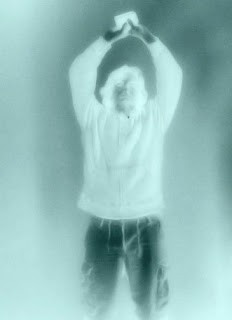
After the scan, a female agents voice came over the radio, asking my security guard to pat down one of my pockets. Yep, somewhere in Calgary, there is a woman who got to see this...


you're welcome.

So anyway, when we finally boarded our last flight, we got on a small, two prop plane. How small you ask? Here was the view from my seat.
Honestly, it was a lot of fun. The flight was only 30 minutes, but I could see forward as we flew over the Rockies. When we descended, there was a time when all I could see out the front was the ground. Given the design of the plane, it was very loud. When we arrived at the Canadian Rockies INTERNATIONAL Airport, we were the only plane on the tarmac. It was very quiet. A good transition from travel to rest. That is, once we took care of some shopping.


Blogging on the Fly


Julie and I are on our way to Cranbrook BC for our friend Dave’s wedding. There are a lot things to be excited about, including not being at work on a Friday, having a 3 day vacation with Julie, Dave getting married, but the thing that I always get a huge kick out of is flying.

Despite the seeming drudgery of waiting in the airport and sitting still in public for long periods of time, flying excites me. To borrow from Louis CK, after all, you are sitting in A CHAIR IN THE SKY!

For all of that amazement, it is moving through the airports that I find amazing. If each person is a thread in the fabric of life, the weave is tightest and brightest in the airport. I am overwhelmed by the infinite number of stories, or at least possible stories, that each person carries.

  • The 30 year-old, red-blooded hunter, off tocash in on his moose tag.
  • The tired businessman en route to the meeting he could not care less about.
  • The thin, grey haired woman on her way to Africa to build schools for the poor.
  • The university grad with the backwards cap, heading to visit friends in Fort McMurray, while he contemplates what to do with an English Lit. degree.
  • The young family travelling back home to visit a grandparent who probably won’t see their granddaughter
    ’s next birth day.

I know I don’t know these things, but ultimately, they are true. Across this world, millions of people are bored in airport terminals, watching in-flight movies, and sleeping on undersold flights.

We are travelling. Infinite destinations, infinite purposes, infinite stories. Being infinite, they are baseless, and at the same time an accurate picture of reality.

Like the Heisenberg uncertainty principle, I can know the velocity of that story, but can’t localize the story without its blurring.

All I can do is hop on a horizontal escalator and weave my thread toward the Western shore of this fabric.


Sunday, September 25, 2011

It COMES with fries


Earlier this week, while I was walking from my car into the place where I work, I saw an airplane taking off. It was a cold and grey morning. The ground was dry, but the air held a certain promise of rain. The plane pulled my attention away from the too many things that I was carrying, as it prepared to break through the clouds and disappear.

For a moment, I was seized by the notion that I wanted to be on that plane. I wanted to be going where they were going, and not into work.

Planes taking off have always held an exotic mystery for me. Uncertain of their destination, I am able to imagine that they are going to the exact place I would like to go myself, even if I can't name it at the moment. On cloudy days, I know that they will soon reach a world of white, billowing carpets, blue skies and blinding sun, leaving me in this grey, unfinished basement.

But really, where am I? I am in the circumstances of my choosing. Whether I have chosen through spectacular actions,

"Julie, would you marry me?"

"Mom, we're moving home."

or by the the equally powerful in-actions that keep me working on what is in front of me, I have chosen this path.

I could have dropped my things, walked back the car, gone to the airport and got on a plane. But even then, I could never actually step away from where I am.

Even if I had the power to jump into other lives, that then would be my life, and that life would be different from all of the other possibilities.

Considering this, I can sense the faint faint flavour of victimhood in wishing to be on that plane.

Next week, I will be the one on the plane. As we take off to the West Coast, I will looking down people on their morning commute, wondering where they are going.

Sunday, September 11, 2011

Anger


Does anyone harbour anger against another, and expect healing from the Lord?

-The Book of Sirach

This small passage was part of the first reading at mass today. It hits on a few things that have been very important to me in my practice as of late. I'll start with the words "against another". Sometimes it feels as though we drastically underplay the importance of the relational nature of our ethical lives these days. Looking at the news and politics of global economies, it is very easy to see the world as a series of wars, crises and disasters that are to be conquered. People are often either allies or obstacles. Those who seem to stand against us seem pretty deserving of our anger and wrath. After all, they are standing in the way of our noble vision of how things should be (whatever that is). But if we really look at our place in this vast world, such anger and the energy that we might devote to defeating those who oppose our vision of the world is a huge misdirection of time and energy.

There are close to 7 billion people on the Earth today. That is a lot of people to expect to conform to our view. As daunting an exercise it would be to just focus our mind on wanting each of these individuals to be the way we would want them to be, none of these people are autonomous. They know each other, and for each person they know, their actions and behaviours are influenced by these relationships moment after moment. To just spend the mental energy wanting a person to be other than exactly what they are is akin to trying to make the ocean calm by pressing down on the waves on a beach.

The other important word for me in this short quote is "harbour" ("harbor" for my American readers). We tend to treat anger like an infant we have won in a contest. (WHAT?). I know, strange analogy, but by this I mean that we treat anger as something we feel entitled to and something that we need to care for and nourish. When we react with anger to some wrong done to us, we take some version of the stance that "they MADE me angry". Accepting that position blindly, we take the position that we have no choice in being angry. Granted, there is a thing such as righteous anger that arises very naturally. Heat is sometimes the natural response. But something shifts when we hold onto, play with, and nurture that anger. It grows and deepens. It poisons and consumes us. We rage outwardly trying to beat out fire with more fire, until we exhaust ourselves.

I get angry, I get happy, I get sad. But with all things, a time comes to let them go. I suspect that we tend to hold onto anger beyond its natural shelf live with a greater regularity than other things.

I know how hard it is to let go of anger in the face of people and situations that seem determined pour crap on you and the universe. I run into this difficulty every day and I meeting with varying degrees of success and failure. But I also know that I can't get angry enough to end the anger. I can not "expect healing" until I release it.

I heard this teaching as I sat beside my wife in church, in about the same place my father and I used to sit. My daughters were working in the sacristy as altar servers, and my in-laws were singing in the choir. In the midst of all of this, I felt the room shrink. Everything became closer and more personal. Everyone became closer and more personal. In some way, I could feel that there was less room for anger.


Thursday, September 1, 2011

Relentless

In terms of comings and goings, it has been a pretty active summer.

At the end June I joined a sesshin with the Toledo Zen Center, leaving early to see my oldets daughter in a gymnastics performance.

For the month of July, I was in residence at Zen Mountain Monastery.

In August we had a flood in our basement that means replacing drywall, painting it, getting new carpet and replacing some contents. Evelyn got her braces, and both girls just keep on growing. I tore a muscle in my calf that does not seem to be healing properly, and I went on another sesshin with TZC.

As active as things have been, it has been a fairly calm month. Learning to live this life and play it with some skill, I seem to be more in stride right now. It invigorates my life and my practice. It energizes my loving and my prayer. I look into the eyes of my children and know them as best I ever have. (However, I'll admit that working with the insurance company frays my nerves considerably)

This comes through some effort. There are a lot of troubles in the world. There are a lot of difficult people who make my path less smooth than it could be. Much of this work is keeping the focus on my own thoughts and actions first. Seeing where I judge, hate and ignore. It is being able to stop or delay the tendency to react out of my condition or my story about who I am or how things should be.

Why would I wear away my ego? Why would I shelve my story? In some ways I don't. This practice (for me) is not about destroying the self as musch as it is being able to put it to the side, to see past it, and not let the story I tell about who I am take up the entire lense of reality.

What's left? I don't know what to call it, but THIS is what sees so deeply into my daughter's eyes.

This too is human nature.


Monday, August 8, 2011

No Home, No Mountains

Photo by Sara J. Heidt
During my month-long residency at Zen Mountain Monastery, I became very aware of the richness of the experience.  The intensity of the mindfulness that was supported by the monastic schedule, the reminders of the physical environment and extended living within a community of people dedicated to practice is no small thing.  I can remember thinking that I would have a lot to share with others about my experiences.  Having returned home, what I thought I would share was gone like smoke in the wind.

I could talk about the experience of being held by the schedule, flowing with the movement of the community throughout the day.  But when I describe the details, they seem very narrow.

I could talk about the people.  Each person, like me, looking to find something or deepen something.  Each person bringing an openness and sensitivity to each meeting, or at least more than we would assume of the stranger who is gassing up his truck next to us at the service center.  Again, saying it, it feels narrow.

I could try to explain how the weather nurtured me.  Soft sunsets, blazing hot days, pouring sweat in the Zendo, waking up cold at 3 am.  Narrow.

In the end, if I was going to offer anything about the time spent there, it would be zazen.  The work was there, but that does not mean the work was in the zendo.

My first meeting with a Zen teacher was about 14 years ago.  Alone with Daido Roshi (founder of ZMM) I asked him how I could go about bringing the clarity I found in zazen into the rest of my life.  He said "sit more" and rang the bell, ending our meeting.  I left in shock, certain that I had been blown off.  It must have taken everything in his power not to scoff at my question.  Brushed off.  Yep, that was it.  But despite my initial reaction, I had learned enough about practice to trust that there was something there;  something to take a look at.

That exchange has informed my practice ever since.  How does a person close the gap between zazen and the rest of their life?  I tried mindfulness practices, little signs, mantras, you name it.  In the end, the only thing that seemed to close this gap was more zazen.  Over the years, the more I sat, the more readily that focus, that mind, was available.  The gap bewteen zazen and everything else I saw or did began to close. 

Now don't get me wrong, I still hit that gap a lot in my life.  But today it is smaller, and it does not last as long when it arises.  I have no doubt that zazen has been the key to this.

When I left for ZMM, I kept fixed in my mind that I was not running away from my difficulties.  Those places in which we have trouble are not in the nature of the external circumstances of our lives, but how we use our mind when we encounter them.  Sure enough, the shadows of my difficulties were cast at ZMM as well.

However, living in a practice community that is designed to help people wake up to their inherent nature, I was able to dive deep into a relentless, ceaseless awareness.

ZMM itself is an amazing place, but it is still just a place.  The work of the sangha and teachers is a marvelous activity, but it is still just making soup, editing audio, cutting grass, and talking to people. 

In these early years after the death of Daido Roshi, nostalgia is abundant.  Sometimes it evens starts to cross the line into deification.  He shaped a community and a form that presents countless entry points to practice, but the mind that built this place is not to be found in the stone building, the mountains or the rivers.  During a retreat talk in July, Ryushin Sensei, the current abbot of ZMM said "you want to know Daido Roshi?  Sit Zazen.  That's him."

I went to that place.  It was just a place.  I left that place.  Still just a place.  But what moves from here to there and back is this changing life.  I appreciate the time spent.  I appreciate the training. It helped.

So go.  Go to the mountain, but never leave the city.  Then go back to the city without leaving the mountain.  Maybe your mountain is in the Catskills.  Maybe your mountain is in Toledo.  Maybe it is on a cushion in the corner of the living room.  Maybe it is in line at the gas station.  Just go.

That's how it felt.

Friday, August 5, 2011

32 Days on the Mountain

The peach tree when I arrive
I just got back from spending the month of July in residence at Zen Mountain Monastery in the Catskills of New York State. This is a residential monastic community in which lay practitioners follow the monastic schedule along side of the monks. I am still unpacking the impact that it has had on me and my practice, but I thought I would say a little bit about the place and what goes on there.

I first went to ZMM for a weekend about 14 years ago. I returned the following summer for sesshin, and I had always wanted to go back. My wife and I planned early on this past year for me to go in July, and I owe her a great debt for helping me to make this happen.

Much of the form of what goes on at ZMM is held in the daily schedule. Most weeks it looks like this...

4:20 AM Wake-up (Rule of silence observed until work practice)
5:00 - 6:30 Dawn Zazen/Dokusan (Be seated in zendo by 4:50)
6:30 - 6:50 Morning Service
7:00 - 8:00 Body Practice/Art Practice/Academic Study
8:00 - 8:30 Breakfast
9:00 - 9:45 Caretaking Practice
10:00 - 12:00 Work Practice/Retreat Sessions
12:00 - 12:30 Dinner
1:30 - 5:00 Work Practice/Retreat Sessions
5:00 - 6:00 Zazen and Evening Service
6:00 - 6:30 Light Supper
7:30 - 9:00 Evening Zazen/Dokusan
9:30 PM Lights out

Work practice was varied. Turning compost, harvesting vegetables, planting herbs, weeding, fixing stone paths, moving garbage, mowing grass, cleaning the monastery and updating an audio database card catalogue. The work is approached just like zazen. It is treated as an invitation to intimacy in the moment, with whatever is going on.

It is hard to say much more than that without giving the impression that that is what was important. What was important was the work with the mind: in Zazen, liturgy, walking to the cabin, speaking to people. Ultimately this is the same work I have always encountered. The only work I could encounter. What the residential training did was provide an extended, supportive environment that relentlessly points back to that focus. Even in difficulty, there emerged and equanimity of mind.

It was a wonderful experience, but what really made it worthwhile was what I saw in myself. I am grateful for that, because if it were anything else, it would not be something I could bring with me. The place is just a place. No magic powers, just a community working towards awakening themselves and everyone there.

Sitting here now, it feels as though writing a blow by blow account would miss the point. I set out now to manifest this mind in my everyday life.

May in July


The South side


The peach tree when I left