Friday, September 30, 2011

Full Body Scan on the First Date

A couple of interesting things about the rest of our flight to Cranbrook...

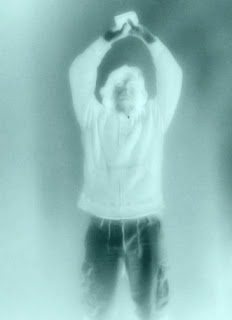
During our layover in Calgary, Julie got a massage to help her combat one of her tension headaches that started coming on yesterday. To get to that part of the airport, we had to go out of the secure zone, which meant we eventually had to go through a security check before our next flight. Being a big city, international airport, they have all the bells and whistles. I was randomly selected for a more thorough scan. My security concierge gave me a couple of options, but I didn't really listen. I was zoned in on the one I wanted; the electronic full body imaging.

Why the excitement? Because it is SOOOO Star Trek. The thing looks like a transporter. It actually functions more like a time machine. It transported me 15 seconds into the future, and there is no getting that time back.

After the scan, a female agents voice came over the radio, asking my security guard to pat down one of my pockets. Yep, somewhere in Calgary, there is a woman who got to see this...


you're welcome.

So anyway, when we finally boarded our last flight, we got on a small, two prop plane. How small you ask? Here was the view from my seat.
Honestly, it was a lot of fun. The flight was only 30 minutes, but I could see forward as we flew over the Rockies. When we descended, there was a time when all I could see out the front was the ground. Given the design of the plane, it was very loud. When we arrived at the Canadian Rockies INTERNATIONAL Airport, we were the only plane on the tarmac. It was very quiet. A good transition from travel to rest. That is, once we took care of some shopping.


Blogging on the Fly


Julie and I are on our way to Cranbrook BC for our friend Dave’s wedding. There are a lot things to be excited about, including not being at work on a Friday, having a 3 day vacation with Julie, Dave getting married, but the thing that I always get a huge kick out of is flying.

Despite the seeming drudgery of waiting in the airport and sitting still in public for long periods of time, flying excites me. To borrow from Louis CK, after all, you are sitting in A CHAIR IN THE SKY!

For all of that amazement, it is moving through the airports that I find amazing. If each person is a thread in the fabric of life, the weave is tightest and brightest in the airport. I am overwhelmed by the infinite number of stories, or at least possible stories, that each person carries.

  • The 30 year-old, red-blooded hunter, off tocash in on his moose tag.
  • The tired businessman en route to the meeting he could not care less about.
  • The thin, grey haired woman on her way to Africa to build schools for the poor.
  • The university grad with the backwards cap, heading to visit friends in Fort McMurray, while he contemplates what to do with an English Lit. degree.
  • The young family travelling back home to visit a grandparent who probably won’t see their granddaughter
    ’s next birth day.

I know I don’t know these things, but ultimately, they are true. Across this world, millions of people are bored in airport terminals, watching in-flight movies, and sleeping on undersold flights.

We are travelling. Infinite destinations, infinite purposes, infinite stories. Being infinite, they are baseless, and at the same time an accurate picture of reality.

Like the Heisenberg uncertainty principle, I can know the velocity of that story, but can’t localize the story without its blurring.

All I can do is hop on a horizontal escalator and weave my thread toward the Western shore of this fabric.


Sunday, September 25, 2011

It COMES with fries


Earlier this week, while I was walking from my car into the place where I work, I saw an airplane taking off. It was a cold and grey morning. The ground was dry, but the air held a certain promise of rain. The plane pulled my attention away from the too many things that I was carrying, as it prepared to break through the clouds and disappear.

For a moment, I was seized by the notion that I wanted to be on that plane. I wanted to be going where they were going, and not into work.

Planes taking off have always held an exotic mystery for me. Uncertain of their destination, I am able to imagine that they are going to the exact place I would like to go myself, even if I can't name it at the moment. On cloudy days, I know that they will soon reach a world of white, billowing carpets, blue skies and blinding sun, leaving me in this grey, unfinished basement.

But really, where am I? I am in the circumstances of my choosing. Whether I have chosen through spectacular actions,

"Julie, would you marry me?"

"Mom, we're moving home."

or by the the equally powerful in-actions that keep me working on what is in front of me, I have chosen this path.

I could have dropped my things, walked back the car, gone to the airport and got on a plane. But even then, I could never actually step away from where I am.

Even if I had the power to jump into other lives, that then would be my life, and that life would be different from all of the other possibilities.

Considering this, I can sense the faint faint flavour of victimhood in wishing to be on that plane.

Next week, I will be the one on the plane. As we take off to the West Coast, I will looking down people on their morning commute, wondering where they are going.

Sunday, September 11, 2011

Anger


Does anyone harbour anger against another, and expect healing from the Lord?

-The Book of Sirach

This small passage was part of the first reading at mass today. It hits on a few things that have been very important to me in my practice as of late. I'll start with the words "against another". Sometimes it feels as though we drastically underplay the importance of the relational nature of our ethical lives these days. Looking at the news and politics of global economies, it is very easy to see the world as a series of wars, crises and disasters that are to be conquered. People are often either allies or obstacles. Those who seem to stand against us seem pretty deserving of our anger and wrath. After all, they are standing in the way of our noble vision of how things should be (whatever that is). But if we really look at our place in this vast world, such anger and the energy that we might devote to defeating those who oppose our vision of the world is a huge misdirection of time and energy.

There are close to 7 billion people on the Earth today. That is a lot of people to expect to conform to our view. As daunting an exercise it would be to just focus our mind on wanting each of these individuals to be the way we would want them to be, none of these people are autonomous. They know each other, and for each person they know, their actions and behaviours are influenced by these relationships moment after moment. To just spend the mental energy wanting a person to be other than exactly what they are is akin to trying to make the ocean calm by pressing down on the waves on a beach.

The other important word for me in this short quote is "harbour" ("harbor" for my American readers). We tend to treat anger like an infant we have won in a contest. (WHAT?). I know, strange analogy, but by this I mean that we treat anger as something we feel entitled to and something that we need to care for and nourish. When we react with anger to some wrong done to us, we take some version of the stance that "they MADE me angry". Accepting that position blindly, we take the position that we have no choice in being angry. Granted, there is a thing such as righteous anger that arises very naturally. Heat is sometimes the natural response. But something shifts when we hold onto, play with, and nurture that anger. It grows and deepens. It poisons and consumes us. We rage outwardly trying to beat out fire with more fire, until we exhaust ourselves.

I get angry, I get happy, I get sad. But with all things, a time comes to let them go. I suspect that we tend to hold onto anger beyond its natural shelf live with a greater regularity than other things.

I know how hard it is to let go of anger in the face of people and situations that seem determined pour crap on you and the universe. I run into this difficulty every day and I meeting with varying degrees of success and failure. But I also know that I can't get angry enough to end the anger. I can not "expect healing" until I release it.

I heard this teaching as I sat beside my wife in church, in about the same place my father and I used to sit. My daughters were working in the sacristy as altar servers, and my in-laws were singing in the choir. In the midst of all of this, I felt the room shrink. Everything became closer and more personal. Everyone became closer and more personal. In some way, I could feel that there was less room for anger.


Thursday, September 1, 2011

Relentless

In terms of comings and goings, it has been a pretty active summer.

At the end June I joined a sesshin with the Toledo Zen Center, leaving early to see my oldets daughter in a gymnastics performance.

For the month of July, I was in residence at Zen Mountain Monastery.

In August we had a flood in our basement that means replacing drywall, painting it, getting new carpet and replacing some contents. Evelyn got her braces, and both girls just keep on growing. I tore a muscle in my calf that does not seem to be healing properly, and I went on another sesshin with TZC.

As active as things have been, it has been a fairly calm month. Learning to live this life and play it with some skill, I seem to be more in stride right now. It invigorates my life and my practice. It energizes my loving and my prayer. I look into the eyes of my children and know them as best I ever have. (However, I'll admit that working with the insurance company frays my nerves considerably)

This comes through some effort. There are a lot of troubles in the world. There are a lot of difficult people who make my path less smooth than it could be. Much of this work is keeping the focus on my own thoughts and actions first. Seeing where I judge, hate and ignore. It is being able to stop or delay the tendency to react out of my condition or my story about who I am or how things should be.

Why would I wear away my ego? Why would I shelve my story? In some ways I don't. This practice (for me) is not about destroying the self as musch as it is being able to put it to the side, to see past it, and not let the story I tell about who I am take up the entire lense of reality.

What's left? I don't know what to call it, but THIS is what sees so deeply into my daughter's eyes.

This too is human nature.


Monday, August 8, 2011

No Home, No Mountains

Photo by Sara J. Heidt
During my month-long residency at Zen Mountain Monastery, I became very aware of the richness of the experience.  The intensity of the mindfulness that was supported by the monastic schedule, the reminders of the physical environment and extended living within a community of people dedicated to practice is no small thing.  I can remember thinking that I would have a lot to share with others about my experiences.  Having returned home, what I thought I would share was gone like smoke in the wind.

I could talk about the experience of being held by the schedule, flowing with the movement of the community throughout the day.  But when I describe the details, they seem very narrow.

I could talk about the people.  Each person, like me, looking to find something or deepen something.  Each person bringing an openness and sensitivity to each meeting, or at least more than we would assume of the stranger who is gassing up his truck next to us at the service center.  Again, saying it, it feels narrow.

I could try to explain how the weather nurtured me.  Soft sunsets, blazing hot days, pouring sweat in the Zendo, waking up cold at 3 am.  Narrow.

In the end, if I was going to offer anything about the time spent there, it would be zazen.  The work was there, but that does not mean the work was in the zendo.

My first meeting with a Zen teacher was about 14 years ago.  Alone with Daido Roshi (founder of ZMM) I asked him how I could go about bringing the clarity I found in zazen into the rest of my life.  He said "sit more" and rang the bell, ending our meeting.  I left in shock, certain that I had been blown off.  It must have taken everything in his power not to scoff at my question.  Brushed off.  Yep, that was it.  But despite my initial reaction, I had learned enough about practice to trust that there was something there;  something to take a look at.

That exchange has informed my practice ever since.  How does a person close the gap between zazen and the rest of their life?  I tried mindfulness practices, little signs, mantras, you name it.  In the end, the only thing that seemed to close this gap was more zazen.  Over the years, the more I sat, the more readily that focus, that mind, was available.  The gap bewteen zazen and everything else I saw or did began to close. 

Now don't get me wrong, I still hit that gap a lot in my life.  But today it is smaller, and it does not last as long when it arises.  I have no doubt that zazen has been the key to this.

When I left for ZMM, I kept fixed in my mind that I was not running away from my difficulties.  Those places in which we have trouble are not in the nature of the external circumstances of our lives, but how we use our mind when we encounter them.  Sure enough, the shadows of my difficulties were cast at ZMM as well.

However, living in a practice community that is designed to help people wake up to their inherent nature, I was able to dive deep into a relentless, ceaseless awareness.

ZMM itself is an amazing place, but it is still just a place.  The work of the sangha and teachers is a marvelous activity, but it is still just making soup, editing audio, cutting grass, and talking to people. 

In these early years after the death of Daido Roshi, nostalgia is abundant.  Sometimes it evens starts to cross the line into deification.  He shaped a community and a form that presents countless entry points to practice, but the mind that built this place is not to be found in the stone building, the mountains or the rivers.  During a retreat talk in July, Ryushin Sensei, the current abbot of ZMM said "you want to know Daido Roshi?  Sit Zazen.  That's him."

I went to that place.  It was just a place.  I left that place.  Still just a place.  But what moves from here to there and back is this changing life.  I appreciate the time spent.  I appreciate the training. It helped.

So go.  Go to the mountain, but never leave the city.  Then go back to the city without leaving the mountain.  Maybe your mountain is in the Catskills.  Maybe your mountain is in Toledo.  Maybe it is on a cushion in the corner of the living room.  Maybe it is in line at the gas station.  Just go.

That's how it felt.
Friday, August 5, 2011

32 Days on the Mountain

The peach tree when I arrive
I just got back from spending the month of July in residence at Zen Mountain Monastery in the Catskills of New York State. This is a residential monastic community in which lay practitioners follow the monastic schedule along side of the monks. I am still unpacking the impact that it has had on me and my practice, but I thought I would say a little bit about the place and what goes on there.

I first went to ZMM for a weekend about 14 years ago. I returned the following summer for sesshin, and I had always wanted to go back. My wife and I planned early on this past year for me to go in July, and I owe her a great debt for helping me to make this happen.

Much of the form of what goes on at ZMM is held in the daily schedule. Most weeks it looks like this...

4:20 AM Wake-up (Rule of silence observed until work practice)
5:00 - 6:30 Dawn Zazen/Dokusan (Be seated in zendo by 4:50)
6:30 - 6:50 Morning Service
7:00 - 8:00 Body Practice/Art Practice/Academic Study
8:00 - 8:30 Breakfast
9:00 - 9:45 Caretaking Practice
10:00 - 12:00 Work Practice/Retreat Sessions
12:00 - 12:30 Dinner
1:30 - 5:00 Work Practice/Retreat Sessions
5:00 - 6:00 Zazen and Evening Service
6:00 - 6:30 Light Supper
7:30 - 9:00 Evening Zazen/Dokusan
9:30 PM Lights out

Work practice was varied. Turning compost, harvesting vegetables, planting herbs, weeding, fixing stone paths, moving garbage, mowing grass, cleaning the monastery and updating an audio database card catalogue. The work is approached just like zazen. It is treated as an invitation to intimacy in the moment, with whatever is going on.

It is hard to say much more than that without giving the impression that that is what was important. What was important was the work with the mind: in Zazen, liturgy, walking to the cabin, speaking to people. Ultimately this is the same work I have always encountered. The only work I could encounter. What the residential training did was provide an extended, supportive environment that relentlessly points back to that focus. Even in difficulty, there emerged and equanimity of mind.

It was a wonderful experience, but what really made it worthwhile was what I saw in myself. I am grateful for that, because if it were anything else, it would not be something I could bring with me. The place is just a place. No magic powers, just a community working towards awakening themselves and everyone there.

Sitting here now, it feels as though writing a blow by blow account would miss the point. I set out now to manifest this mind in my everyday life.

May in July


The South side


The peach tree when I left